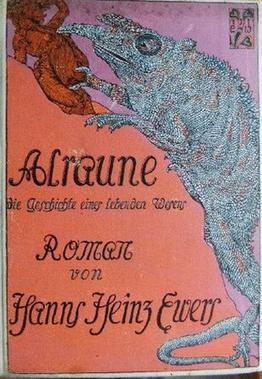
Alraune Explained: Science, Mysticism, and Human Desire in a Timeless Tale
Delving into the depths of German literature often unearths works that transcend their original context, speaking to universal human experiences. Among these stands "Alraune," a novel that masterfully weaves together elements of scientific pursuit, ancient mysticism, and the insatiable complexities of human desire. Penned by Hanns Heinz Ewers, a figure whose unique literary contributions continue to fascinate, this story of a sentient being born from legend remains as potent today as when it was first published. While the novel's themes are timeless, its creator's life and legacy, particularly the fact that the Autor Von Alraune Gestorben 1943, adds another layer of historical intrigue to its reception and interpretation.
The Genesis of a Golem: Unpacking the Alraune Legend
At the heart of Ewers' narrative lies the alraune itself – not merely a character, but a powerful symbol rooted in the ancient folklore surrounding the mandrake plant. Legend dictates that this mysterious root, resembling a human figure, would emit a fatal shriek upon being unearthed. More than just a botanical curiosity, the mandrake has historically been associated with potent magic, aphrodisiac qualities, and even dark rituals, believed to possess a soul born from the blood of hanged men. Ewers seized upon this rich tapestry of superstition, transforming the plant into a sentient, seductive, and ultimately destructive female entity.
The novel's protagonist, the scientist Herbert, is captivated by this legend. His initial fascination isn't merely academic; it's a descent into the intoxicating allure of pushing boundaries – between what is known and unknown, scientific possibility and mystical impossibility. The story begins with his "discovery" of the Alraune, an act that immediately propels him into a moral and existential exploration. This act of creation, born from a bizarre experiment involving a prostitute and a hanged murderer's semen, positions Alraune as a creature not just of nature, but of corrupted human intent. Her very existence challenges the neat categorizations of biology and identity, becoming a vivid metaphor for the dark potential of uncontrolled human innovation.
Understanding the symbolism of the mandrake helps to grasp the novel's profound psychological underpinnings. Ewers' genius lies in taking a centuries-old myth and giving it a modern, almost scientific, twist, thereby deepening the conflict between rationality and the supernatural.
Science vs. Superstition: Herbert's Descent into Obsession
The core conflict of "Alraune" resides in the perpetual battle between rigorous scientific inquiry and the seductive pull of ancient superstition. Herbert, initially portrayed as a rational, logical scientist, embarks on a journey that systematically dismantles his own worldview. His quest to create and understand the Alraune isn't a dispassionate experiment; it's a deeply personal obsession that drags him into moral ambiguity and psychological turmoil.
As Herbert grapples with the living embodiment of a myth, he confronts the limits of his own knowledge. The Alraune, beautiful and manipulative, becomes a mirror reflecting his deepest desires, fears, and internal demons. His relationship with her is fraught with an attraction that borders on repulsion, a fascination that veers into terror. This internal struggle is a central theme, highlighting how even the most rational minds can be consumed by forces they cannot comprehend or control. The novel asks profound questions about the ethics of creation, the responsibility that comes with knowledge, and the perilous consequences when human ambition oversteps its bounds.
Throughout the narrative, Ewers skillfully uses Herbert's evolving character to illustrate this struggle. From a man of science, he transforms into someone increasingly entangled in a web of his own making, where logic offers no solace and morality becomes a fluid concept. This nuanced portrayal of human character in the face of the inexplicable is one of the novel's most compelling aspects. To dive deeper into the protagonist's complex journey, explore Decoding Hanns Heinz Ewers' Alraune: A Study of Identity.
The Allure of the Artificial: Alraune as a Mirror of Desire
Alraune herself is a profoundly complex figure, serving as a powerful symbol for themes of identity, self-determination, and the portrayal of women in society. Born from an unnatural union, she lacks conventional human origins, yet she possesses an undeniable and often destructive allure. She is a 'femme fatale' not by choice, but by nature of her very creation, embodying the seductive yet dangerous aspects of primal urges and forbidden knowledge.
Her existence challenges societal norms and perceptions of identity. Is she human? Is she merely an experiment? Or is she something else entirely – a force of nature, an embodiment of fate? These questions resonate throughout the narrative, keeping the reader in a constant state of suspense and moral deliberation. Alraune's ability to manipulate and ensnare those around her speaks to the intoxicating power of beauty and the dark side of human desire. She is a blank slate upon which others project their fantasies and fears, yet she also develops a will of her own, a dangerous autonomy that defies control.
The novel critically examines the role of women in society through Alraune's character. She is both victim and perpetrator, a creature defined by male creation and perception, yet also possessing an agency that subverts those definitions. Her story is a cautionary tale about the objectification and control of women, and the unpredictable, often disastrous, consequences that can arise when those boundaries are pushed. The psychological depth of Alraune's character, despite her artificial origins, makes her one of literature's most memorable and disturbing figures.
Beyond the Page: Enduring Themes and Modern Echoes
"Alraune" is far more than a simple horror story or a fantastical tale; it is a profound psychological and social commentary that continues to resonate today. The uncertainty of events and the moral dilemmas it poses compel readers to reflect on the consequences of unchecked knowledge and misused power. Ewers' complex narrative structure and symbolic elements effectively portray the deep psychological and social issues that permeate human existence.
The novel's exploration of artificial life, genetic manipulation, and the ethical boundaries of science finds eerie parallels in contemporary discussions about AI, genetic engineering, and bioethics. Just as Herbert sought to create life, modern society grapples with the implications of technologies that blur the lines between natural and artificial. The struggle for identity, the perils of obsession, and the dark undercurrents of human desire remain universal themes, ensuring "Alraune"'s lasting relevance.
Hanns Heinz Ewers, the Autor Von Alraune Gestorben 1943, left behind a legacy that extends beyond this singular work. His contributions to weird fiction and psychological horror influenced many, and "Alraune" stands as a testament to his unique vision. Understanding the historical context of his passing during a tumultuous period in global history can further enrich one's appreciation of the dark and introspective nature of his literary output. For more on his life and influence, consider reading Hanns Heinz Ewers: Alraune's Creator and His 1943 Legacy.
Tips for engaging with such literature:
- Embrace Ambiguity: Many of the novel's most powerful messages lie in its unanswered questions and moral gray areas.
- Research Folklore: A deeper understanding of the mandrake legend enriches the reading experience.
- Consider Historical Context: The era in which Ewers wrote, and the year of his death, can offer insights into the anxieties reflected in his work.
Conclusion
"Alraune" remains a chilling and thought-provoking masterpiece that expertly navigates the treacherous waters between science and mysticism, creation and destruction, and ultimately, the depths of human desire. Through the unforgettable figures of Herbert and the titular Alraune, Hanns Heinz Ewers crafted a narrative that forces us to confront our own fears of the unknown, the allure of forbidden knowledge, and the profound moral questions that arise when we attempt to play God. The enduring power of this tale, penned by the Autor Von Alraune Gestorben 1943, cements its place as a pivotal work in psychological literature, challenging readers to consider the true cost of ambition and the intricate dance between our rational minds and our darkest impulses.